New projects of 10 or more homes would set aside 10% for families at 60% of area income, $70,680 for four. Buford Highway would need more. Vote Wednesday.
Every new apartment or housing development in Brookhaven with 10 or more homes would have to rent or sell at least 10% of them below market under a zoning rewrite the Planning Commission takes up Wednesday.
Today that rule applies only when the city grants a rezoning or a special land use permit. The draft would also lower the income line. Set-aside homes would go to households earning no more than 60% of the area median income, down from 80%. For a family of four in metro Atlanta, that is $70,680 a year instead of $94,250.
The proposal is text amendment TA26-01. Its full draft, a staff summary table and a slide presentation are in the agenda for the Nov. 4 Planning Commission meeting.
When and where
The commission meets at 7 p.m. Wednesday, Nov. 4, at 2665 Buford Highway. The item has a public hearing before the vote, and the agenda gives a Zoom link for people who cannot attend.
The commission makes a recommendation. The City Council has the final vote, and no council date for the amendment had been posted on the city’s meeting portal as of Saturday.
The amendment first went to the commission on Sept. 2 and returns as unfinished business with a draft revised Oct. 27. City staff said in the presentation that since the last discussion they have met with:
- representatives of LaVista Park, the neighborhood next to the Buford Highway corridor
- the Atlanta Regional Commission
- council member John Funny, whose District 4 includes Buford Highway
What would change citywide
The current rule dates from 2018. It requires 10% workforce housing, at or below 80% of the area median income, only in projects that need a rezoning or special permit. The draft would change that:
- Who it covers: all new residential developments with 10 or more units.
- How much: at least 10% of the homes.
- Income limit: no more than 60% of the area median income.
- How long: at least 20 years, under a recorded agreement with the city. No certificate of occupancy would be issued until that agreement is filed in DeKalb County’s real estate records.
- What the homes must be like: built on site, similar in finishes and appliances to the market-rate units, spread through the building, not grouped together, and with the same mix of bedrooms. Developers would also have to file a marketing plan.
- Fee break: a project that provides at least 5 percentage points more than required could get the same percentage off its permit fees, though not off trade permits.
The draft also lets a developer pay a fee instead of building some of the required homes. The money would go to a new Affordable Housing Trust Fund. The ordinance text says the fee can cover “up to ten percent (10%) of the required units.” The staff summary table describes it differently: developers could pay instead for up to half of the required units, with at least 50% still built on site. The documents do not reconcile the two.
Staff worked out sample fees with a method from the Urban Institute. The draft says the council would set the schedule each year, so these are illustrations, not final prices.
| Unit type | Fee per unit at 80% AMI | Fee per unit at 60% AMI |
|---|---|---|
| Studio | $88,442.65 | $177,101.97 |
| One-bedroom | $94,883.72 | $189,767.44 |
| Two-bedroom | $113,774.60 | $227,763.86 |
| Three-bedroom | $131,162.79 | $262,754.92 |
Buford Highway would need more
Inside the Buford Highway Overlay, the zoning district along the corridor, the minimum would be higher. A development of 10 or more homes would choose one of two options:
- 15% of homes below market: 5% at 80% of area median income, 5% at 60% and 5% at 40%
- 20% of homes at 60% of area median income
The staff table says 10% “is not enough” on Buford Highway, where a larger share of people qualify.
A project that goes further, with 25% of its homes at 60% or 20% at 40%, would get these incentives:
- apartments allowed by right, with no rezoning, on any lot in the overlay that is not zoned for single-family houses
- permitting and development fees waived
- shops, restaurants, offices, banks and medical offices allowed by right on the ground floor of a mixed-use building; pawnshops and “convenient cash businesses” excluded
- private open space, such as courtyards for residents, allowed to count toward the open space rule, with the community development director’s approval
- variances heard by the City Council instead of the Board of Appeals
The height bonus would grow too. A developer would get one extra story for every 5% of workforce homes above the minimum, up to two stories above the zoning limit. Today it takes 10% for one story. Staff wrote that the current bonus has not been used “at all,” because of the cost of building high-rise apartments in concrete and steel.
The draft keeps the transitional buffer rules that protect neighboring homes. Staff said they spelled that out for LaVista Park residents who “wanted reassurance that there would still be protections.”
Why the city says it is needed
The staff presentation sets out the numbers behind the proposal, from Census and National Low Income Housing Coalition figures:
- Brookhaven’s median gross rent was $1,882 in 2024, against $1,120 in 2015.
- The median home value was $692,700 in 2024.
- 31% of households spend more than 30% of their income on housing.
Average Brookhaven rents in the presentation are above what the current rule allows at 80% of area median income:
| Unit type | Average Brookhaven rent | Maximum rent at 80% AMI |
|---|---|---|
| Studio | $1,762 | $1,650 |
| One-bedroom | $1,854 | $1,768 |
| Two-bedroom | $2,347 | $2,122 |
| Three-bedroom | $3,199 | $2,451 |
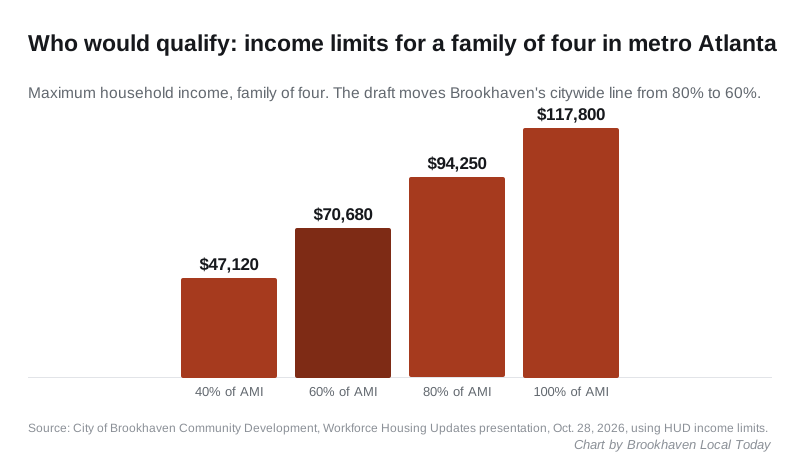
The presentation lists the jobs at each income level. At 60% of area median income it names teachers, detectives and therapists. At 40% it names office administrators, dental technicians and MARTA drivers.
The current rule has produced set-aside units at five projects, according to the city’s affordable housing strategy as of July 2026:
| Project | Total units | Workforce units | Status |
|---|---|---|---|
| AMLI Brookhaven | 630 | 63 | Complete |
| Bellamy at Executive Park | 345 | 35 | Complete |
| Manor Druid Hills | 382 | 38 | Permits pending |
| Panorama Apartments | 205 | 21 | Permits pending |
| Corporate Square | 1,720 | 172 | Permits pending |
The presentation also says the city has bought two Buford Highway parcels and is working with the DeKalb Housing Authority on 120 affordable rental units, projected for 2028.
What it means for you
- If you rent in Brookhaven: more new buildings would include homes priced for households at or below 60% of area median income. The rule applies to new projects only, so it does not change rent in existing buildings.
- If you live near Buford Highway: apartments and mixed-use buildings could be approved without a rezoning hearing when they meet the higher set-aside. That would mean fewer public hearings on individual projects along the corridor.
- If you want to comment: speak at the public hearing Wednesday, in person or on Zoom, or watch for the City Council hearing once it is scheduled. Our 2027 budget story has the council’s other hearings this month.
Have your say