The version going to the City Council lets developers pay a fee instead of building any required below-market homes. The council put off its vote to Dec. 1.
Updated Nov. 18: the City Council held its public hearing on the amendment Nov. 17 and deferred a decision to its next meeting, at 6:30 p.m. Tuesday, Dec. 1, the city said in its Nov. 17 meeting wrap-up. The wrap-up does not say whether the in-lieu fee language will change before then.
Developers in Brookhaven could pay the city a fee instead of building any of the below-market homes a new zoning rule would require. That is the version of the workforce housing amendment the City Council takes up Tuesday, Nov. 17.
The draft the Planning Commission considered on Nov. 4 allowed the fee for “up to ten percent (10%) of the required units.” The version dated Nov. 5 in the council’s agenda drops that limit. It says a developer “may elect to pay an in-lieu fee” in place of the on-site requirement. The fee is worked out per unit and multiplied by “the total number of required affordable housing units.”
The council’s agenda packet does not include the Planning Commission’s recommendation. It also does not say why the limit was removed.
When and where
The council holds a public hearing on the amendment, case TA26-01, and then votes on it at its regular meeting at 6:30 p.m. Tuesday, Nov. 17, at City Centre, 4001 Peachtree Road. A staff presentation on the amendment is on the agenda for the 4:30 p.m. work session the same afternoon.
The regular meeting agenda says written public comment can be sent by email to the City Clerk’s Office, with a phone number, name and address. The same meeting has the final hearing and adoption vote on the 2027 budget and the Windsor Parkway rezonings in Lynwood Park.
What else changed in the Nov. 5 version
We compared the Nov. 5 draft with the Oct. 27 draft in the Planning Commission’s Nov. 4 agenda. Besides the fee, three things are new:
- Prices in public. The marketing rule now requires unit prices and fees for the workforce homes to be “publicly available on the website.”
- Impact statement. Redevelopment of existing residential property would need a Housing Affordability Impact Statement, on a form from city staff.
- Definition. The code’s definition of workforce housing moves to households earning no more than 60% of the area median income, from 80%. That matches the new requirement.
What stays the same
The core of the rule did not change between the two drafts:
- Citywide: every new development of 10 or more homes would set aside at least 10% for households earning no more than 60% of the area median income. For a family of four in metro Atlanta that is $70,680 a year, according to the staff presentation for Nov. 17.
- How long: at least 20 years, under an agreement recorded in DeKalb County’s real estate records before any certificate of occupancy.
- Buford Highway Overlay, option 1: 20% of homes below market, made up of 5% at 80% of area median income, 10% at 60% and 5% at 40%.
- Buford Highway Overlay, option 2: 20% of homes at 60% of area median income.
- Bigger incentives: apartments by right and waived permitting and development fees for projects on the corridor that set aside 25% at 60%, or 20% at 40%.
- Height bonus: one extra story for every 5% of workforce homes above the minimum, up to two stories over the zoning limit.
What the fee could cost
The fee money would go to an Affordable Housing Trust Fund. The staff presentation says the fund could subsidize other affordable homes, set up a city land trust to build affordable developments or pay for rental assistance.
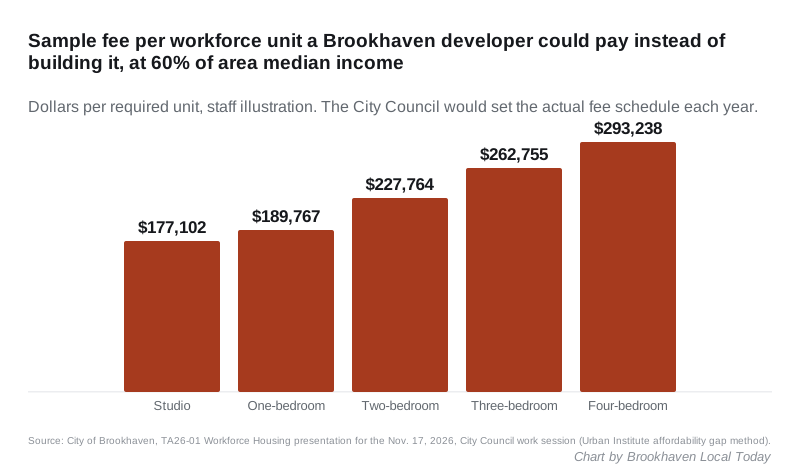
Staff worked out sample fees with a method from the Urban Institute. It takes the gap between a market rent and the rent a qualifying household can afford, and capitalizes it. The draft says the council would set the actual schedule each year, so these are illustrations. At 60% of area median income, the level the citywide rule uses, the sample fees per required unit are:
| Unit type | Sample fee per unit at 60% AMI |
|---|---|
| Studio | $177,101.97 |
| One-bedroom | $189,767.44 |
| Two-bedroom | $227,763.86 |
| Three-bedroom | $262,754.92 |
| Four-bedroom | $293,237.92 |
As an illustration, a 100-unit building would owe 10 workforce homes. Paid at the sample two-bedroom rate, the fee for all 10 would come to $2,277,638.60.
Correction to our earlier story
Our Oct. 31 story on the draft said option 1 on Buford Highway was 15% of homes, with 5% at 60% of area median income. That figure came from the staff summary table. The ordinance text in both drafts says 10% at 60%, for a total of 20%. The earlier story now carries a correction.
What it means for you
- If you rent in Brookhaven: a fee option with no limit means some new buildings might include no below-market homes at all. The money would instead go to the trust fund for affordable housing elsewhere or for rental help. Existing rents are not affected.
- If you live near Buford Highway: the higher corridor set-aside and the by-right incentives are unchanged from the draft the Planning Commission saw.
- If you want to comment: speak at the hearing at 6:30 p.m. Tuesday, Nov. 17, or email the City Clerk’s Office before then, as the agenda describes.
Have your say